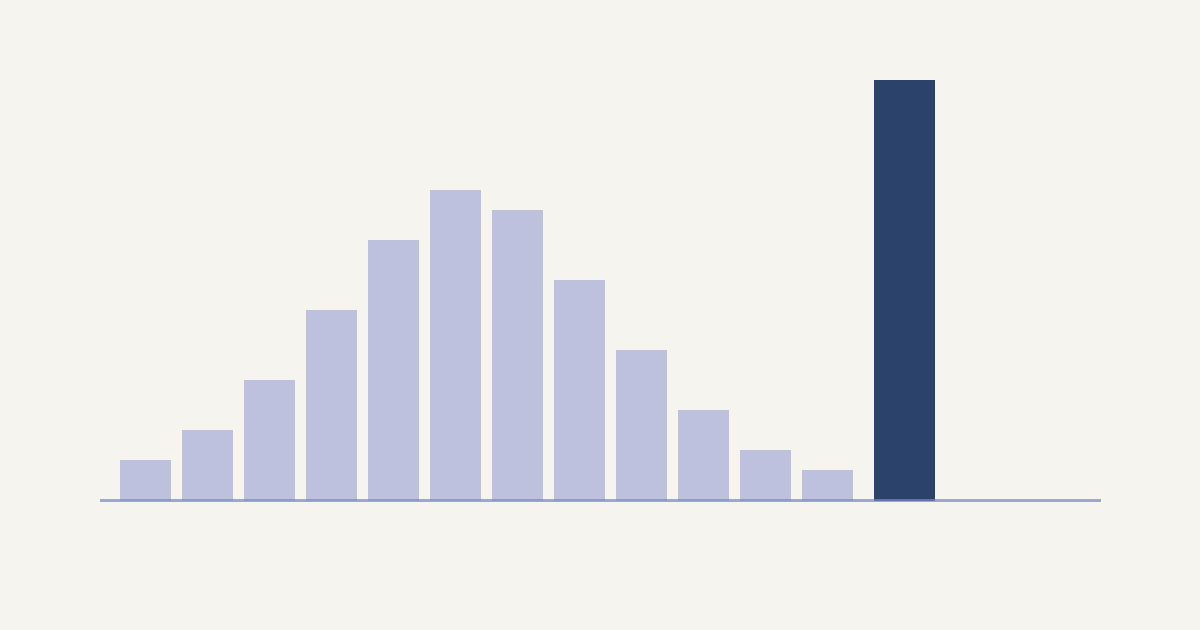
In spring 2026, a Brown University economics professor reported that his class had produced an unusual result: on a take-home midterm taken by 86 students, 40 scored a perfect 100. That reported anomaly, and not any detection software, is what triggered what Fortune described as the largest known AI-assisted cheating scandal in the Ivy League. The allegations have not been adjudicated, so this article treats them as allegations. What makes the case worth studying is what it reveals about AI cheating in university exams as a collective pattern, and about how institutions notice it.
What was reported
Professor Roberto Serrano moved his advanced economics course (ECON 1170) to take-home exams after a December 2025 shooting on the Brown campus, on the grounds that many students were anxious about sitting in a classroom, according to Inside Higher Ed. Reporting on his account states that the class average on the take-home midterm was about 96, against a usual range of roughly 65 to 80, despite an exam he considered harder than in previous years. He and his graders reportedly ran the questions through ChatGPT and found that many student answers mirrored its output in logic and phrasing. He told students he suspected widespread use of AI and moved the final exam in person. Other outlets have reported the number of implicated students as at least 50; that figure comes from his account, not from a finding by the university.
The institutional response, and the disagreement over it
Serrano has said the university acted only after his account was published by the Spanish newspaper El Pais in late June. A Brown spokesperson told the Boston Globe that the academic code committee had been waiting for more information from him and opened its investigation as soon as he provided it on July 8, and that academic leaders had been in contact with him about the adjudication process earlier. The two accounts are not reconciled in public reporting, and this article takes no side on them. Separately, a Brown committee on generative AI in teaching and learning published its first report in the same period; according to Inside Higher Ed, three-quarters of the 105 faculty members who gave feedback said they were concerned about students using AI to cheat.
Evidence, inference, and what remains open
| Category | What it contains in this case |
|---|---|
| Reported facts | 86 students took the exam; 40 scored 100; the average was about 96 versus a usual 65 to 80; the exam was take-home for reasons connected to campus safety |
| Allegations | Serrano alleges widespread AI use, at least 50 students by some reports; the university’s investigation began in July 2026 and has not produced a public finding |
| Our interpretation | The visible signal was a statistical anomaly in the score distribution, not the output of a detector |
| Not established | Which individual students used AI, how they used it, and whether the score pattern has any other explanation |
Why the anomaly, not a detector, exposed it
This part is our interpretation, but the research supports it. AI-text detectors have documented reliability problems: a peer-reviewed 2023 study in Patterns by Liang and colleagues found that widely used detectors misclassified 61% of essays written by non-native English speakers as AI-generated. A score distribution is a different kind of evidence: it does not judge any one student’s text, it flags that a group performed in a way the exam’s history makes unlikely. That makes it useful as a trigger for review and unsuitable as proof against an individual, which is why due process still matters after the anomaly is noticed.
A contrast: not every anomaly means AI
A second 2026 case shows the limits of inferring cause from an anomaly. As CNN reported, Mexico’s UNAM annulled about 3,000 of roughly 150,000 admission exam results after an unusually high number of perfect scores, with suspicion falling on AI tools or advance access to questions. UNAM’s own investigation then reported cheating through phones, accomplices, and identity theft, and the university scheduled an in-person control exam for around 58,000 applicants. Many students also blamed the AI surveillance system meant to make the exam cheat-proof. The lesson is that an unusual score pattern establishes that something went wrong, not what, and that the remedy chosen in both cases was the same: supervised, in-person assessment.
What this means in practice
- Match the format to what you are measuring. A take-home exam can no longer certify unaided ability unless AI use is explicitly part of the task. Where unaided ability is the goal, supervised assessment is the reliable option.
- Plan the contingency. The Brown exam moved out of the classroom for a humane reason. Departments need an AI-resilient fallback format ready for disruptions, so that an emergency does not silently change what the exam can measure.
- Use anomalies to open a review, not to close one. Compare cohort results with course history, then use an oral follow-up or a supervised re-test before any accusation.
- State the rules in the assignment. Explicit, task-level AI-use rules are the operational core of a sound policy; see our guide to building an AI use policy, and AI literacy for the skills a rule alone cannot teach.
What this case does not show
It says nothing about the conduct of Brown students in general, and one class is not a survey of a university. The broader evidence on how widespread misuse is comes from aggregate counts: a Guardian investigation, summarized by The Cheat Sheet, found almost 7,000 proven AI-cheating cases at UK universities in 2023 to 2024, about 5.1 per 1,000 students, and experts described that as the tip of the iceberg because detection is uneven. The pattern also connects to a deeper question we examined in our review of the research on AI and critical thinking: what an exam is for once a capable tool is always within reach.
Key takeaways
- The Brown case rests on allegations: 40 of 86 students scored 100 on a take-home midterm, and the university’s investigation has not issued a public finding.
- The signal that exposed it was a score-distribution anomaly, which supports opening a review but is not proof against any individual. See do AI detectors actually work for the full evidence review.
- UNAM’s 2026 admission-exam case shows an anomaly can have several causes, and both institutions responded with in-person assessment.
- Practical steps: match assessment format to the skill measured, prepare AI-resilient contingencies, and write task-level AI rules into every assignment.
Sources: Inside Higher Ed (July 8, 2026); Fortune (June 2026); Boston Globe (July 15, 2026); CNN (August 2, 2026); Liang et al. (2023), Patterns, 4(7); OECD AI Incidents Monitor entry for the Brown case.