
Posted on — 1 Comment

Who Should Govern AI at Universities? Faculty Rights, Human Oversight, and Academic Work

University faculty members discussing AI governance and academic policy at a meeting

As of 11 October 2026, negotiations at several universities show that the debate over artificial intelligence in higher education is expanding beyond classroom use. The emerging question is who gets to shape the rules when AI affects academic work, employment decisions, privacy, and institutional accountability.

This is not evidence of a single global consensus. The cases discussed here are specific, ongoing negotiations in Australia and Canada, and the parties involved disagree about both the substance of AI safeguards and where those safeguards should be written.

Why AI governance is becoming a workplace issue

Universities increasingly have to make decisions about where AI tools may be used, what information may be entered into them, whether AI contributes to decisions about employees, and how human responsibility is preserved. These questions overlap with teaching and research, but they also concern employment conditions and institutional governance.

Three recent cases illustrate different parts of this debate: negotiations at the University of Melbourne, bargaining between York University and CUPE 3903 in Canada, and the University of Sydney’s stated preference for adaptable policies and frameworks.

1. University of Melbourne: a proposed AI clause, not a settled agreement

In its 8 October bargaining update, the National Tertiary Education Union (NTEU) reported that it had tabled a principles-based AI clause and that the University of Melbourne was engaging with it. The union said it was not seeking to ban AI; it wanted basic protections as AI was already being used. The university acknowledged that AI needed to be addressed in some form, while continuing to develop its position.

The discussion became more specific around disclosure. According to the NTEU’s account, the university was concerned that the draft could require disclosure of AI use in too many decisions. The union clarified that its intended focus was human-resources decisions affecting staff across the employment cycle, including recruitment, major workplace change, promotion, discipline, and performance. The parties were still working on wording on 8 October.

What this means: the question is not simply whether AI is allowed. It is whether staff should be told when AI materially contributes to consequential employment decisions, and how a disclosure rule can be clear without becoming unworkably broad. Because the update is from the union, it should be read as the union’s account of negotiations—not as a jointly agreed summary or a final contract.

2. York University: a joint working group with a recommendatory role

At York University in Canada, CUPE 3903—which represents teaching assistants, contract faculty, graduate and research assistants, and other workers—reported on 4 October that AI had been a major subject in collective bargaining. The union’s bargaining team report says the employer proposed replacing an ad hoc AI committee with a Joint Working Group on the Use of AI in the Workplace.

According to CUPE 3903, the group’s role would be to make recommendations, not implement changes directly, and its work would be deferred until well into the next collective agreement. The union’s report argues that meaningful safeguards should address consent, accountability, information security, academic freedom, and the role of human labour in teaching and research. Those are the union’s stated priorities; they should not be mistaken for agreed university policy.

York’s own labour-relations updates confirm that bargaining has been underway and that the parties have been pursuing conciliation. The university’s public account provides useful context, while the union report offers detail about its interpretation of the AI discussions. Reading both helps distinguish the existence of a negotiation from either side’s preferred outcome.

What this means: creating a working group can bring expertise and consultation into the process, but its practical influence depends on its mandate, timing, access to information, and what decision-makers must do with its recommendations. A committee is not equivalent to a binding safeguard.

3. University of Sydney: policies may be more adaptable than a three-year agreement

The University of Sydney has articulated a different emphasis. In its 2 September statement on industrial action, the university said it supported a human-centred approach to ethical AI and argued that AI should be governed through policies and frameworks that can be updated as technology changes, rather than placing all such rules in an enterprise agreement covering a three-year term.

This is the university’s stated position, not proof that policy-based governance is always more effective. Policies can be revised more readily, which may help institutions respond to fast-changing tools. But their practical strength depends on transparency, consultation, enforcement, and whether staff and students have meaningful ways to challenge decisions. Conversely, putting a principle into a collective agreement may give it a more formal status, but drafting broad language can be difficult and can create questions about scope and implementation.

Policy or collective agreement? The real issue is enforceability

These cases should not be reduced to a simple contest between innovation and resistance. They reveal a governance design problem: how can institutions preserve room to adapt while ensuring that AI use is transparent, proportionate, and accountable?

  • Define high-impact uses. Institutions should distinguish low-stakes support—such as brainstorming—from AI that materially informs hiring, promotion, discipline, performance evaluation, grading, or other consequential decisions.
  • Require meaningful human responsibility. Where an AI system informs a consequential decision, a named human decision-maker should be able to scrutinise its contribution, explain the decision, and correct errors. Human oversight should not be a rubber stamp.
  • Make disclosure specific. Clear rules should identify when AI use must be disclosed, to whom, and what information is needed. Requiring disclosure for every minor use can create noise; providing no disclosure for high-impact use can undermine trust.
  • Protect data and intellectual work. Rules should address confidential student and staff information, research materials, intellectual property, and the limits of uploading sensitive content to third-party systems.
  • Give people a route to challenge outcomes. Students and employees need an accessible process to question an AI-assisted decision and request meaningful human review.
  • Review rules on a schedule. Because systems and practices change, policies and agreements should include consultation, monitoring, and review mechanisms rather than assuming that a single document will answer every future question.

These are recommendations for institutional design, not a claim that any one university has already adopted all of them.

What educators and university leaders should watch next

The important evidence will be the text and implementation of any final agreements or policies—not headlines suggesting that a university has “settled” the AI question. Readers should look for precise definitions of covered AI uses, the scope of disclosure, the role of human decision-makers, data-protection responsibilities, consultation requirements, and review or appeal mechanisms.

For education leaders, the lesson is practical: AI governance should not be treated only as a question of student rules or classroom integrity. It also concerns the conditions under which teaching, research, and institutional decisions are carried out. For faculty and students, the key test is whether the rules create understandable responsibilities and meaningful avenues for accountability.

Conclusion

The current discussions at Melbourne and York, alongside Sydney’s publicly stated approach, show different institutional choices still being debated. They do not establish a settled international trend, and the negotiations may change. They do, however, offer a useful way to examine the central governance question: who sets the limits, who is informed when AI is used, and who remains accountable for the outcome?

Universities do not need to choose between adaptability and safeguards as if only one were possible. The stronger approach is to make the rules transparent, define high-impact uses clearly, preserve meaningful human responsibility, and create processes that can be reviewed as the technology and its educational consequences evolve.

Sources and further reading

Editorial note: This article reflects publicly available information reviewed as of 11 October 2026. The Melbourne and York bargaining accounts include statements from the union parties; proposals and negotiating positions are not final agreements. Readers should consult later official updates for changes after this date.


Posted on — 2 Comments

Beyond Prompting: How Can Schools Measure Real AI Literacy?

Student working at a laptop, representing critical evaluation and AI literacy in education.

As generative AI becomes part of everyday study, a practical question is becoming harder for schools and universities to avoid: how can educators tell whether students are genuinely AI-literate? A student may feel confident using ChatGPT, produce a polished assignment with it, and still struggle to verify a claim, recognize a fabricated reference, decide when AI assistance is inappropriate, or explain the reasoning behind a submitted answer.

This distinction matters because AI literacy is not simply familiarity with a chatbot or the ability to write an effective prompt. It includes understanding what a system can and cannot do, judging the quality of its output, making responsible decisions about its use, and retaining responsibility for learning. Recent research on performance-based testing and assessment-specific AI literacy suggests that education needs more precise ways to measure these capabilities.

This article reviews evidence on AI literacy assessment, considers what current measurement tools can and cannot tell us, and proposes practical principles for educators. It is an evidence-based synthesis of published research, not a report of a new experiment.

The measurement problem: confidence is not competence

Many AI literacy questionnaires ask learners to rate their own knowledge or confidence. Self-reports are useful: they can reveal attitudes, anxiety, perceived ability, and whether students believe they need support. But they do not directly demonstrate that a learner can perform a task successfully.

A systematic review in npj Science of Learning found that, although available AI literacy scales generally showed promising structural validity and internal consistency, relatively few had been tested for content validity, construct validity, responsiveness, or cross-cultural validity. The review also identified far fewer performance-based measures than self-report instruments. This points to a measurement gap, not proof that self-report tools are useless.

A later systematic review in Computers and Education: Artificial Intelligence examined 31 empirical studies using six AI literacy instruments across 14 countries. It found that AI literacy was associated with factors such as self-efficacy, attitudes, motivation, and digital competencies. It also reported differences between relationships measured with self-report scales and those measured with a performance-based test, raising the possibility that self-perceptions can distort how literacy is estimated.

The educational implication is straightforward: a survey can tell a teacher what students think they can do, but a performance task can provide evidence of what they actually do in a defined situation. Strong assessment systems should use each method for the questions it can answer. This distinction builds on the broader question explored in our guide to what AI literacy actually means and complements our analysis of the limits of AI detectors: neither confidence nor a detector score alone can establish what a student understands.

What performance-based assessment adds

One important contribution is the Generative AI Literacy Assessment Test (GLAT), reported in Computers and Education: Artificial Intelligence in December 2025. The researchers developed a 20-item multiple-choice test and evaluated it with 355 higher education students. They reported acceptable reliability and structural validity; GLAT scores also predicted performance on GenAI-supported tasks better than self-ratings such as perceived ChatGPT proficiency.

The finding supports a shift from asking only “How confident are you?” to also asking students to demonstrate knowledge and judgment. However, the evidence should be interpreted within its limits. The study involved a particular instrument and a sample of higher education students. A 20-item test cannot capture every real-world AI skill, and further validation is needed across age groups, languages, disciplines, and changing AI tools.

Performance-based assessment does not have to mean a long, standardized examination. A teacher might ask students to compare two AI-generated explanations, identify unsupported claims, verify a reference, explain why one answer is stronger, or revise an output while documenting what they changed and why. Such tasks make the underlying reasoning more visible than a confidence rating alone.

A second development: assessing AI literacy within academic assessment

A study published in Frontiers in Education on 10 September 2026 developed and validated the Generative AI Assessment Literacy Scale (GAA-LS) for higher education students. Rather than measuring general AI knowledge, it focuses on decisions students face when AI is used in assessed work.

The researchers began with an item pool and used expert review and pilot testing before analysing data from two student samples: 486 students in the first study and 798 in the second. The final 18-item instrument supported five dimensions:

  • Assessment criteria awareness: understanding what the assignment requires and how work will be judged.
  • AI-task appropriateness: deciding when AI assistance is suitable or unsuitable for a particular task.
  • Verification and evidence checking: checking claims, references, and reasoning instead of accepting outputs at face value.
  • Ethical attribution and academic integrity: following disclosure rules and taking responsibility for submitted work.
  • Feedback uptake and revision: using AI-supported feedback critically to improve work rather than accepting it uncritically.

The authors reported satisfactory to strong internal consistency and evidence supporting the scale’s validity, including measurement invariance across gender, discipline, and AI-use-frequency groups in their samples. Scores were positively associated with feedback engagement and intention to maintain academic integrity.

These results are promising, but the distinction between association and causation is essential. The study used a cross-sectional scale-development design; it does not show that raising a student’s score will necessarily improve academic integrity or learning outcomes. The instrument is also focused on higher education and needs further testing across languages, cultures, institutions, and observable behaviours. Because it uses self-report items, it complements rather than replaces performance-based assessment.

What should schools actually measure?

Taken together, the research suggests that AI literacy assessment should cover more than prompt-writing. A practical framework for classroom use can focus on five observable capabilities.

1. Understand the tool and its limits

Can the student explain, in appropriate terms, that generative AI may produce plausible but inaccurate answers? Can they identify situations where a model’s output needs independent checking? The goal is not to require every learner to understand the technical details of a large language model, but to develop an accurate mental model of its strengths and limitations.

2. Evaluate evidence, not just fluency

Give students an AI-generated response containing a mix of accurate statements, unsupported claims, and a questionable reference. Ask them to verify selected claims using credible sources and explain which evidence changed their judgment. A fluent answer should not receive full credit simply because it sounds authoritative.

3. Make appropriate decisions about delegation

Students should be able to distinguish between using AI to brainstorm, request feedback, or practise a skill and handing over the central intellectual work that an assignment is intended to assess. The boundary depends on the learning objective and the teacher’s rules. Assessment instructions should therefore specify permitted, restricted, and prohibited uses instead of relying on vague expectations.

4. Disclose use and retain responsibility

Where disclosure is required, students should be able to describe how AI contributed to their work. They should also be able to defend the reasoning, sources, and final decisions in their submission. Disclosure alone does not prove learning, but it can make the process more transparent and support fairer assessment.

5. Use feedback to improve, not merely to finish

Ask learners to compare AI feedback with a rubric or teacher feedback, decide which suggestions to accept, and explain why they rejected or adapted others. This makes evaluative judgment visible and reinforces the idea that AI-generated feedback is a resource to assess—not an instruction that must automatically be followed.

A practical assessment design for teachers

A balanced approach can combine three kinds of evidence rather than relying on one score:

  • Knowledge check: a short quiz on AI capabilities, limitations, privacy, bias, and responsible use.
  • Authentic performance task: students critique an AI output, verify evidence, improve the answer, and explain their decisions.
  • Process reflection: students record what they delegated, what they checked, what they changed, and what they learned.

A simple rubric might assess the accuracy of verification, the quality of reasoning, the appropriateness of AI use, transparency about assistance, and the student’s ability to explain the final work. The rubric should be shared before the task and aligned with the actual learning objective. It should not reward elaborate prompting if prompting is not the skill the course intends to teach.

This approach also helps avoid a false choice between banning AI and allowing unrestricted use. Different assignments serve different purposes. If the objective is unaided recall or foundational practice, AI may need to be restricted. If the objective is evaluating sources, revising arguments, or using tools responsibly, AI can be included explicitly in the assessment design.

Equity and validity: the cautions that matter

Assessment design must account for unequal access to paid tools, differences in language proficiency, disability accommodations, and students’ prior experience with technology. A test that inadvertently measures subscription access, English fluency, or familiarity with one interface may misrepresent the intended competence.

Tools also change quickly. A test tied to a particular product interface may become obsolete after an update. Durable assessment should focus on transferable judgment: checking evidence, recognizing uncertainty, selecting appropriate support, protecting private information, and explaining decisions.

Finally, no single score should be treated as a complete measure of a student’s AI literacy. Self-report questionnaires, knowledge tests, performance tasks, process evidence, and teacher observation each capture different aspects. Their combination is more informative than any one instrument used in isolation.

What educators and institutions should do next

For teachers, the immediate step is to define the capability a task is meant to assess, then design a short activity that makes that capability observable. For institutions, the priority is to provide consistent rules for acceptable AI use, teach students how to verify outputs, and evaluate assessment methods for fairness and validity.

For researchers, the agenda includes testing instruments across age groups and languages, comparing self-reports with actual performance, and studying whether assessment results predict learning over time. New scales should be evaluated not only for reliability but also for whether they measure the intended construct and work fairly across different student populations.

UNESCO’s guidance on generative AI in education and research provides a broader human-centred framework, emphasizing privacy, age-appropriate use, validation, and the development of educators’ and learners’ competencies. These principles support an approach in which assessment is designed around learning and responsibility rather than around the presence or absence of a particular tool.

Key takeaways

  • AI literacy is broader than prompt-writing or familiarity with a chatbot; it includes evaluation, verification, appropriate use, ethics, and responsibility.
  • Self-report questionnaires can reveal students’ perceptions, but they do not by themselves demonstrate practical competence.
  • The GLAT study, involving 355 higher education students, found that a performance-based test predicted GenAI-supported task performance better than self-ratings in that study.
  • A September 2026 study developed an 18-item scale focused on AI literacy in assessment contexts, covering criteria, appropriate use, verification, attribution, and feedback-based revision.
  • Both instruments have limits and need further validation across contexts; neither should be treated as a universal measure of every AI-related capability.
  • Teachers can begin with authentic tasks that require students to verify, justify, revise, and explain their use of AI.

Editorial conclusion: The central challenge for education is no longer only teaching students how to use AI. It is establishing credible evidence that they can use it thoughtfully, verify what it produces, and remain responsible for their learning. Assessment should make those capabilities visible. Confidence and polished output may be useful signals, but neither is a substitute for demonstrated judgment.

Sources and further reading

  • Jin, Y., Martinez-Maldonado, R., Gašević, D., & Yan, L. (2025). GLAT: The generative AI literacy assessment test. Computers and Education: Artificial Intelligence, 9, 100436. https://doi.org/10.1016/j.caeai.2025.100436
  • Nie, J., Zhang, Z., Lu, X., Zhang, Y., & Zhang, M. (2026). Development and validation of the generative AI assessment literacy scale for higher education students: psychometric evidence and associations with feedback engagement and academic integrity. Frontiers in Education, 11, 1934632. https://doi.org/10.3389/feduc.2026.1934632
  • How AI literacy correlates with affective, behavioral, cognitive and contextual variables: A systematic review. (2025). Computers and Education: Artificial Intelligence, 9, 100493. https://doi.org/10.1016/j.caeai.2025.100493
  • Lintner, T. (2024). A systematic review of AI literacy scales. npj Science of Learning. https://doi.org/10.1038/s41539-024-00264-4
  • UNESCO. (2023). Guidance for generative AI in education and research. UNESCO guidance.

Editorial note: This article synthesizes published research available as of 10 October 2026. Findings from higher education samples should not be assumed to generalize automatically to school-age learners or every educational setting.

Posted on — Leave a comment

AI Safety in Education: Can Teen AI Chatbots Be Trusted?

Student studying at a desk with a laptop

On October 7, 2026, a new independent assessment raised a difficult question for schools and families: can a chatbot designed to help teenagers learn also be trusted to protect them when conversations become risky? The Youth AI Safety Institute at Common Sense Media published an evaluation of OpenAI’s ChatGPT for Teens, reporting that some advertised safeguards did not work reliably in its tests. OpenAI disputed aspects of the testing. The disagreement matters because educational AI is moving beyond occasional homework help toward tools that may become part of students’ daily routines.

The issue is not whether AI can be useful for learning. It is whether the safety claims surrounding products used by minors are supported by evidence—and whether schools, parents, and policymakers have enough information to make informed decisions.

What changed: AI companies are designing for teenage learners

OpenAI introduced ChatGPT for Teens on August 18, 2026. The company describes it as an experience with age-appropriate protections and learning-oriented features, including Study Mode, step-by-step guidance, quizzes, reminders, and optional parental controls. In an October 7 update, it also announced additional learning and college-planning features for teenagers.

The educational rationale is understandable. A conversational system can explain a concept in different ways, offer practice questions, and help a student work through a problem when a teacher or family member is unavailable. These capabilities may widen access to support. But a product used by adolescents is not simply a tutoring tool: it is also a conversational environment that may encounter disclosures about distress, health, relationships, or personal safety.

That combination makes the reliability of safeguards a central educational question, rather than a secondary technical detail.

What the independent assessment found—and what it did not prove

In its October 7 risk assessment, Common Sense Media’s Youth AI Safety Institute said it tested more than 4,000 prompts before and after the teen experience was introduced. The organization reported that some protections worked, including refusals of explicit sexual role-play, while other measures were less reliable. Its concerns included missed crisis referrals, parental alerts that did not consistently trigger in its tests, the ease of moving from Study Mode to direct answers, and responses that could make the chatbot seem more person-like than intended.

The Institute rated the product an “Unacceptable Risk” for children and teenagers and recommended restricting access until the problems were addressed. That rating is the Institute’s conclusion, not a universal scientific consensus. The assessment is a structured product evaluation, not a randomized study of students’ learning outcomes or a peer-reviewed clinical trial. Its results identify concrete failure modes worth investigating, but they do not by themselves establish how often those failures occur across all users, settings, versions, or real-world conversations.

OpenAI has said the testing does not accurately represent how its safeguards work in practice. Reporting by the Associated Press also notes that the organization conducting the assessment receives funding from industry, including technology companies it evaluates. That funding relationship is relevant context for readers, but it does not automatically invalidate the results; the appropriate response is to examine the methods, disclose limitations, and seek independent replication.

The most defensible conclusion is therefore narrower than either “the chatbot is safe” or “the chatbot is unsafe in every circumstance”: the assessment raises credible questions about whether particular safeguards work as advertised, and those questions require transparent, repeatable testing.

Why this matters for learning—not only for online safety

1. Safety is part of educational quality. A learning tool should be judged not only by how clearly it explains algebra or summarizes a text, but also by how it responds when a student is vulnerable, confused, or seeking help beyond its competence. A failure in those moments can undermine trust in the entire learning environment.

2. Study support and academic shortcutting can coexist. OpenAI presents Study Mode as a way to encourage hints, guided reasoning, and knowledge checks rather than simply supplying answers. The Institute reported that some tested routes still allowed students to obtain direct answers. This does not show that guided learning is ineffective; it shows why claims about how a feature behaves should be tested in realistic conditions. Teachers should continue to design tasks that require explanation, reflection, and evidence of a student’s own reasoning.

3. Parental controls need clear limits. A setting that encourages Study Mode is not necessarily a hard restriction, and a safety notification is not a guarantee that every concerning conversation will be detected. Families and schools need plain-language descriptions of what controls do, what they do not do, what data is shared, and when a human must intervene.

4. Human relationships remain essential. Conversational AI can sound supportive, but it is not a teacher, counsellor, parent, or emergency service. Systems should make that distinction clear and should direct users toward appropriate real-world help when necessary. Educators should avoid positioning a chatbot as a substitute for trusted adults or professional support.

A useful framework already exists

UNESCO’s Guidance for Generative AI in Education and Research argues for a human-centred approach, including data privacy, age-appropriate use, validation of systems, and the development of educators’ and learners’ AI competencies. Published in 2023 and updated online in 2026, the guidance predates this particular product dispute, but its core principle is directly relevant: educational institutions should not assume that a widely available AI tool is pedagogically or ethically suitable without evaluating it.

For schools, this suggests a practical procurement and use checklist. Before recommending an AI tool to minors, ask:

  • Has its safety performance been evaluated independently, using transparent methods and age-appropriate scenarios?
  • Are the product’s age rules, privacy practices, parental controls, and escalation procedures explained clearly?
  • Can teachers distinguish a learning-support feature from a control that actually prevents certain actions?
  • Does the tool encourage students to reason, verify, and reflect—or does it routinely complete the task for them?
  • Is there a clear human support pathway for sensitive or high-risk situations, and a process for reporting failures?
  • Will the school review the tool again after updates, rather than treating a single assessment as permanent proof of safety?

What evidence should come next?

The next step should not be to settle the debate through competing headlines. AI companies should publish measurable, age-specific safety results and explain how tests translate into product changes. Independent evaluators should publish methods, limitations, and reproducible findings. Researchers should examine not only whether a system refuses dangerous requests, but also whether it recognizes when a student needs human support, whether controls behave as users understand them to behave, and how repeated use affects learning and help-seeking over time.

Schools, meanwhile, can take proportionate precautions without abandoning educational experimentation: use approved tools with clear policies, teach students to question AI outputs, avoid sharing sensitive personal information, keep teachers involved in assessment, and never treat a chatbot as the sole support for a student in crisis.

Key takeaways

  • AI tutoring features may expand access to individualized explanations and practice, but usefulness does not automatically establish safety.
  • A Common Sense Media evaluation published on October 7, 2026, reported weaknesses in some ChatGPT for Teens safeguards; OpenAI disputed aspects of the testing.
  • The evaluation is important evidence about possible failure modes, but it is not a peer-reviewed study of student outcomes or proof that every interaction is unsafe.
  • Schools should assess privacy, age-appropriateness, crisis pathways, parental controls, and learning design—not just product features.
  • The most credible path forward is transparent company reporting, independent replication, and continued human responsibility for students’ wellbeing and learning.

Editorial conclusion: The emerging issue is not whether teenagers will encounter AI, but whether the systems marketed to support their learning can demonstrate that their protections work under realistic conditions. For education, responsible adoption requires evidence, clear limits, and human oversight—not confidence based on product claims alone.

Sources and further reading

Posted on — 1 Comment

AI Tutors for Students: What the New Study Agents Mean for Learning

Abstract illustration in warm sand representing stacked study cards

The latest wave of educational AI is moving beyond the chatbot. OpenAI has just expanded ChatGPT for Teens with college-planning support, flashcards and quizzes, while Microsoft is positioning its Study and Learn Agent around guided practice rather than simply supplying answers. Anthropic is also building education-specific capabilities for teachers. The direction is clear: major AI companies are trying to turn general-purpose models into AI tutors for students.

But the important educational question is not whether these systems can explain a concept, generate a quiz or answer a student’s question. They can. The harder question is whether giving students an AI tutor actually produces more learning.

Recent evidence gives a much more cautious answer than the current technology race might suggest.

The trend: from AI answers to AI study agents

On 7 October 2026, OpenAI reported early usage data from ChatGPT for Teens and announced new learning-oriented features. Students can turn notes into flashcards and interactive quizzes, while a forthcoming College Planner is designed to help high-school students organize applications, deadlines and financial-aid tasks. OpenAI also says that, among teens using its learning tools, common requests include developing ideas, receiving feedback and checking evidence. OpenAI’s announcement.

Microsoft is pursuing a similar direction with its Study and Learn Agent. The company describes it as a learning-focused system that asks students to think before it tells them, using scaffolding, quizzes, flashcards and other activities. It is explicitly designed around the principle that the learner does the thinking. Microsoft’s documentation.

This is a significant shift in product design. The educational AI market is moving from the model of “ask the chatbot” toward “work with an AI tutor”: a system intended to question, prompt, scaffold, diagnose misconceptions and provide practice.

That shift is educationally important because the quality of an AI interaction depends not only on what the model knows, but also on what the student is required to do.

What does the research actually show?

The strongest reason for caution is that access to an AI tutor is not the same thing as effective tutoring.

A two-year cluster-randomized experiment in 18 Tennessee middle schools provides one of the clearest recent tests. Students using Khan Academy with the AI tutor Khanmigo achieved gains in mathematics of roughly 0.06–0.08 standard deviations over a school year. However, the researchers found that these gains were comparable to those produced by Khan Academy practice without AI. Although 96% of students tried Khanmigo at least once, the median student used it on only about one third of practice days and in only 17% of sessions in which they made a mistake. The researchers therefore identify student engagement with the tutor, rather than mere access, as a major constraint. Oreopoulos & Low, NBER Working Paper 35620 (2026).

Even more striking is a randomized university study published in October 2026. The study involved 2,379 undergraduate students and 30 instructors across multiple disciplines. Access to a course-integrated generative-AI tutor was associated with a 0.37 standard-deviation reduction in final grades and a 0.90-standard-deviation reduction in learning-management-system participation. The researchers suggest that the AI tutor may have displaced participation in existing learning activities rather than improving learning. The estimated losses were also larger among first-generation students. Liu et al., EdWorkingPapers (2026).

These two studies should not be treated as contradictory proof that AI tutoring is either good or bad. They show something more useful: the educational effect depends heavily on implementation, student behavior, task design and the surrounding course.

The wider evidence points in the same direction

A 2026 systematic review and meta-analysis of generative AI in STEM education examined 85 eligible studies, with 49 studies and 59 effect sizes included in the quantitative synthesis. It found an overall positive effect on cognitive learning outcomes, but the heterogeneity was extremely high (I² = 96.32%), with a very wide prediction interval. In other words, the average result hides substantial differences between contexts and interventions. Boolzen, Kuhn & Flegr (2026).

The OECD’s Digital Education Outlook 2026 reaches a similar conclusion from a policy and evidence perspective. General-purpose GenAI can improve the quality of students’ immediate outputs without producing equivalent learning gains when it removes the cognitive work that students need to perform themselves. By contrast, AI designed or used with a clear pedagogical purpose has greater potential to support learning. The OECD specifically highlights the possibilities of AI tutors that question, nudge and adapt their support rather than simply deliver solutions. OECD (2026).

This distinction is fundamental. Better performance on an AI-assisted task is not automatically evidence of better learning. A student can submit a better answer while acquiring less of the knowledge or skill required to produce that answer independently.

Why the design of the AI tutor matters

Learning requires cognitive activity. Students need to retrieve information, explain ideas, compare alternatives, make mistakes, receive feedback and revise their thinking. A system that removes all of those difficulties may feel efficient while quietly removing the very processes through which learning occurs.

This is why the most promising AI tutor is not necessarily the one that produces the best answer. It may be the one that produces the best learning sequence.

For example, an educational AI system can:

  • ask a student to attempt a problem before revealing a solution;
  • identify a misconception and ask a diagnostic question;
  • request an explanation in the student’s own words;
  • generate progressively harder practice questions;
  • compare two possible arguments and ask the student to defend one;
  • provide feedback without rewriting the student’s work for them;
  • ask the student to verify an AI-generated claim against a source.

These designs preserve what educational researchers call productive cognitive effort. They also align with the OECD’s emphasis on pedagogical purpose and with the emerging direction of purpose-built tools from major AI companies.

What could this mean for students?

1. More individualized support

The strongest promise of AI tutors is availability. A student who gets stuck at home does not have to wait until the next lesson to ask a question. AI can provide explanations, examples and practice at a pace that fits the learner.

For students who have limited access to tutoring, this could be particularly valuable. But access must not be confused with effectiveness: the evidence shows that students still need to engage actively with the learning process.

2. A new risk of educational dependency

If students learn that every difficult step can immediately be outsourced, they may become less willing to struggle with unfamiliar problems. The danger is not simply “cheating”; it is the gradual weakening of independent problem solving.

The relevant question for educators therefore becomes: What intellectual work remains with the student?

3. AI literacy becomes part of learning itself

Students now need to evaluate not only books, websites and teachers’ explanations, but also machine-generated explanations. They need to ask: Is this claim accurate? What evidence supports it? What might the system have misunderstood?

The OECD and European Commission’s 2026 AI Literacy Framework places this capacity at the center of education: learners should understand AI, critically evaluate its outputs and use it ethically and creatively. OECD/European Commission (2026).

4. The AI divide may become a learning-behavior divide

The problem may no longer be simply who has access to AI. It may be who knows how to use it well.

Recent Microsoft Research work involving 318 university students found that proactive and critical AI engagement was associated with better learning outcomes, while learner background differences were partly explained by differences in how students interacted with AI. This suggests that the ability to use AI productively could itself become an educational advantage. Microsoft Research (2026).

A particularly important lesson for Morocco

The issue is already highly relevant to Moroccan students. According to the OECD’s PISA 2025 country findings, 45% of students in Morocco reported using AI chatbots to help them learn at least once a week, almost identical to the OECD average of 46%. Thirty-six percent reported using AI for preliminary research, 30% for summarizing texts and 29% for drafting writing assignments. Only 9% said they never or almost never used AI for the schoolwork tasks examined by PISA. OECD, PISA 2025: Morocco.

At the same time, the Moroccan data reveal an important inequality: the gap between advantaged and disadvantaged students in opportunities to assess the quality of AI-generated information was among the widest observed across participating systems. This suggests that the educational challenge is not simply to give students access to AI. Schools also need to teach students how to interrogate AI.

For Moroccan education, this means that banning AI alone is unlikely to be a sufficient long-term strategy. A more productive approach would distinguish between AI use that replaces learning and AI use that strengthens learning.

What should teachers do now?

Teachers do not need to turn every lesson into an AI lesson. Instead, they can establish a few clear principles:

  1. Require an attempt before AI assistance. Students should demonstrate initial thinking before receiving extensive support.
  2. Use AI for feedback rather than substitution. Ask the system to identify weaknesses or pose questions rather than rewrite the entire answer.
  3. Make verification part of the task. Students should check important AI claims against textbooks, academic sources or reliable data.
  4. Assess the process. Drafts, oral explanations, reflections and problem-solving steps can reveal learning better than a final AI-assisted product alone.
  5. Teach AI literacy explicitly. Students need to understand hallucinations, bias, uncertainty, privacy and the limits of automated reasoning.

The real question is not whether students will have AI tutors

The latest announcements from OpenAI, Microsoft and other AI companies suggest that AI tutoring will become increasingly embedded in everyday student life. The technological trend is therefore unlikely to be reversed.

But the research does not support a simple claim that AI tutors automatically improve education. Some interventions show positive effects. Others show little added value. A recent randomized university study even found substantial negative effects on grades and participation. The strongest common lesson is that pedagogy mediates technology.

The future of AI in education will therefore not be decided by which company builds the most capable tutor. It will be decided by whether educational systems can design environments in which students still have to think, retrieve, explain, question, verify and create.

An AI tutor should make the student more capable, not make the student less necessary.

Research note

This article is an evidence-based synthesis of recent company announcements, randomized studies, systematic research and international policy evidence. It does not present original empirical research. The findings cited here vary in population, intervention and research design; therefore, causal claims should not be generalized beyond the contexts studied.

Selected references

  • OpenAI. (2026). Helping teens learn, plan, and shape the future of AI.
  • Oreopoulos, P., & Low, N. (2026). One Click Away: AI Tutoring with Khanmigo in a Two-Year School Experiment. NBER Working Paper 35620. DOI: 10.3386/w35620.
  • Liu, J., et al. (2026). The Effects of Course-Integrated AI Tutoring on Student Performance and Engagement: A Randomized University Trial. EdWorkingPaper 26-1598. DOI: 10.26300/y3f8-vh05.
  • Boolzen, C., Kuhn, J., & Flegr, S. (2026). Evidence of impact and interpretational limits of generative AI in STEM education. Artificial Intelligence Review, 59, 223. DOI: 10.1007/s10462-026-11665-9.
  • OECD. (2026). OECD Digital Education Outlook 2026: Exploring Effective Uses of Generative AI in Education. DOI: 10.1787/062a7394-en.
  • OECD/European Commission. (2026). Empowering Learners for the Age of AI: An AI Literacy Framework for Primary and Secondary Education. DOI: 10.1787/65cd27d4-en.
  • OECD. (2026). PISA 2025 Results: Morocco.
Posted on — Leave a comment

AI Watermarking in Education: What OpenAI’s New Move Means for Students, Teachers, and Assessment

Abstract illustration in periwinkle representing layered AI literacy frameworks

Artificial intelligence is entering a new phase in education. The question is no longer simply whether students, teachers, and researchers use generative AI. Increasingly, institutions are asking a harder question: Can we determine how AI was involved in producing a piece of work?

On October 5, 2026, OpenAI announced a new approach to text provenance for ChatGPT and Codex. The company said it would begin introducing an invisible, machine-readable watermark into eligible AI-generated text for users in the European Union. The technology, called textGrain, creates a statistical signal through model word choices that can later be detected by an authorized system. The move responds to transparency requirements under the EU AI Act. OpenAI’s announcement.

Key finding: AI watermarking can provide a provenance signal, but it does not establish authorship, measure human contribution, identify the user, or prove academic misconduct.

From AI detection to AI provenance

An AI detector generally asks: Does this text look as if it was generated by AI? A provenance system asks a narrower question: Does this text contain a signal associated with a particular AI system?

OpenAI’s textGrain belongs to the second category. It does not insert visible labels, hidden characters, or unusual punctuation. It subtly influences statistical choices among possible words or word pieces, creating a pattern that a detector can search for.

This distinction matters enormously in education. A watermark may provide evidence that an AI system contributed to a passage. It does not establish how much of the work came from AI, what instructions the student provided, what the student understood, or whether the final submission represents meaningful human reasoning.

Why AI watermarking matters for assessment

Generative AI has challenged a basic assumption behind traditional assessment: the submitted product is evidence of the student’s learning. That assumption becomes weaker when students can use AI to generate essays, solve problems, summarize readings, write code, translate text, and produce presentations.

But replacing traditional assessment with AI detection creates another problem. Consider two students: one copies an AI-generated essay without understanding it; another researches independently, uses AI for feedback, challenges its claims, verifies sources, and substantially develops the final argument. Both may have interacted with AI, but their learning processes are completely different.

A binary question—“Was AI used?”—cannot adequately distinguish between them.

The scientific limitation: watermarks are not perfect

OpenAI reports that detection becomes more difficult with shorter passages and subjects where there is less flexibility in word choice, such as mathematics. Editing can also substantially weaken the watermark. In one evaluation, replacing 10% of words with synonyms reduced detection from about 92% to 66%; replacing 25% reduced it to 17%.

These findings have an immediate implication for schools and universities: a watermark should not be treated as a definitive verdict about authorship. A positive result may indicate that an AI system generated or processed some text. An absence of a watermark does not prove human authorship.

OpenAI also says that a watermark does not measure human contribution, establish ownership or responsibility, identify the user, or verify content accuracy.

Assessment may need to move from products to processes

The most important educational consequence of AI watermarking may be the acceleration of a transition from product-based assessment toward process-aware assessment.

Educators can increasingly evaluate research processes, drafts and revisions, oral explanations, source evaluation, problem-solving steps, reflective commentary, project development, classroom discussion, and the student’s ability to defend conclusions.

This does not mean abandoning essays or examinations. It means recognizing that the final text alone may no longer provide sufficient evidence of learning when generative AI is widely available.

AI literacy becomes part of learning

If students are going to work with AI, education needs to teach them how to work critically with AI. AI literacy includes evaluating AI-generated information, identifying unsupported claims, verifying sources, recognizing uncertainty, protecting sensitive information, understanding model limitations, disclosing AI assistance when appropriate, distinguishing assistance from substitution, and taking responsibility for final work.

The objective should not simply be to teach students how to use AI. It should be to teach them how to think when AI is available.

What teachers should do

AI prohibited

Students complete the task without generative AI.

AI assisted

Students may use AI for brainstorming, language assistance, or feedback but must produce and verify the substantive work themselves.

AI integrated

Students are explicitly asked to use AI and critically evaluate its output. For example: Use an AI system to explain a scientific problem, identify weaknesses in its answer, verify its sources, and produce a corrected explanation.

In this model, AI becomes not a shortcut around learning, but an object through which learning takes place.

What universities should avoid

Universities should be cautious about turning AI detection into an automated disciplinary mechanism. A detection signal should not automatically lead to a finding of misconduct. Students should have an opportunity to explain their work, demonstrate understanding, provide drafts where relevant, and respond to the evidence.

The purpose of assessment is ultimately not to identify machines. It is to understand learning.

What are we actually assessing?

A polished essay can demonstrate writing ability, but it may also demonstrate access to tools. A correct mathematical answer can demonstrate understanding, but it may also demonstrate the ability to obtain an answer from a machine. A programming assignment can demonstrate coding competence, but it may also demonstrate the ability to supervise an AI coding system.

None of this makes assessment meaningless. It means that assessment design must evolve alongside the technology.

What OpenAI’s watermark really changes

Text watermarking does not solve the AI cheating problem, create a perfect AI detector, or tell a teacher whether a student has genuinely learned something. What it represents is a move toward a world in which AI-generated content can carry provenance signals.

For education, this could support transparency—but provenance should be combined with better assessment. The strongest response is likely to combine provenance + human judgment + AI literacy + process-based assessment + clear institutional policy.

Conclusion

OpenAI’s textGrain announcement may be an early step toward a new norm of digital transparency. But education should resist the temptation to equate AI origin with misconduct.

The real challenge is bigger: schools and universities need to redesign learning environments in which students can use powerful AI systems without outsourcing the cognitive abilities education is supposed to develop.

The goal should not be classrooms where AI is impossible to use. It should be classrooms where using AI does not make thinking unnecessary.


Research basis

This article is an analytical synthesis of current reporting and official regulatory material. It does not present original empirical research.

Related reading: Generative AI in Education: What the Research Says About Learning and Assessment · Do AI Detectors Actually Work? What the Evidence Shows

Posted on — Leave a comment

Generative AI in Education: What the Research Says About Learning and Assessment

Abstract illustration in periwinkle representing layered AI literacy frameworks

Generative AI in education has moved from a question of technological possibility to a question of educational design. The central issue is no longer simply whether students and teachers will use tools such as large language models, but how those tools should be integrated into teaching, learning and assessment without weakening the purposes education is meant to serve.

This article reviews recent peer-reviewed research and international guidance to identify what the evidence currently supports, where findings remain uncertain, and what the shift means for educators and institutions. It is a research synthesis, not an original empirical study.

Key finding: Recent research does not support a simple “AI is good” or “AI is bad” conclusion. Outcomes depend substantially on the pedagogical task, the way students use the tool, the role assigned to AI, and how learning is assessed.

Why generative AI changes the educational question

Generative AI can produce text, explanations, examples, code, images and other forms of content on demand. That changes the relationship between a learner and a conventional educational task. A student may now obtain a plausible explanation, draft an argument or receive feedback before submitting work that previously required more independent production.

UNESCO’s guidance on generative AI in education and research frames this development as a question of human-centred educational design. It emphasizes human agency, inclusion, equity, data protection, appropriate validation of AI systems and the need to consider how AI affects what is taught, how it is taught and how learning is assessed. UNESCO, 2023.

This distinction matters. The educational value of a generative AI system cannot be inferred from the quality of its output alone. A fluent answer may help a learner understand a difficult concept, but the same answer can also bypass the cognitive work that an assignment was designed to elicit.

What recent research tells us about learning

A 2025 systematic review in the International Journal of Educational Technology in Higher Education examined 63 peer-reviewed studies of AI-based learning tools in higher education. The review identified assessment and evaluation, personalized feedback and recommendations, and intelligent tutoring among the main roles of AI-based tools. It also examined cognitive, skill-based and affective learning outcomes rather than treating “learning” as a single measure.

Another 2025 systematic review in TechTrends synthesized research on pedagogical applications of generative AI in higher education. Taken together with other reviews, the literature indicates that generative AI is being used across teaching, learning support, feedback, content generation and assessment-related activities, but the research base remains heterogeneous.

A 2025 meta-analysis of 57 studies and 97 effect estimates reported positive effects of generative AI on several university learning outcomes, including language skills, academic achievement, affective-motivational outcomes and higher-order thinking. However, the same analysis found no statistically significant effect on metacognition and identified substantial variation associated with learners, tools, roles, rules and learning contexts. The implication is important: positive average effects do not mean that every use of generative AI produces better learning.

In practical terms, the strongest interpretation of the current evidence is conditional. AI can function as a scaffold, tutor, feedback partner or source of examples, but the educational design still determines whether the learner is thinking, checking, explaining and applying—or simply accepting an answer.

The assessment problem is bigger than plagiarism

The most visible educational debate has focused on academic misconduct: whether a student used AI to produce work that was expected to be independently authored. That issue is real, but it is only one part of a broader assessment problem.

If a conventional assignment can be completed largely by generating a plausible response, the institution may lose information about the student’s reasoning process. The question therefore becomes: What exactly is the assessment intended to measure?

A 2025 systematic review of the early impact of AI on higher-education curriculum, instruction and assessment found that the emergence of generative AI was putting pressure on established assessment practices and on how academics design curriculum and instruction. A later systematic review focused specifically on university assessment similarly identified academic integrity, AI literacy, ethics and institutional governance as connected issues.

Research published in 2026 on generative AI and 21st-century skills assessment adds another dimension. Its systematic review argues that skills such as critical thinking, creativity, communication and collaboration remain relevant, while suggesting that assessment methods need to capture processes and evidence of learning rather than relying exclusively on conventional outputs.

What assessment can look like in an AI-enabled environment

The evidence does not imply that every assessment should become an oral examination or that written assignments should disappear. Instead, it points toward greater variety and stronger alignment between the learning objective and the evidence collected.

  • Process evidence: drafts, revisions, research notes, problem-solving steps or reflective explanations can make learning more visible.
  • Authentic tasks: students can be asked to apply concepts to unfamiliar cases, local problems or discipline-specific situations.
  • Oral or dialogic components: short discussions can test whether a student can explain and defend the reasoning behind submitted work.
  • AI-use disclosure: where AI is permitted, students can document how they used it, what they accepted or rejected, and how they verified outputs.
  • Portfolio assessment: a collection of work over time can provide more evidence of development than a single generated product.

These approaches do not eliminate the need for academic integrity policies. They change the emphasis from trying to detect every possible instance of AI assistance toward designing assessments in which meaningful evidence of learning is harder to outsource.

AI literacy becomes part of the learning objective

Generative AI introduces a new literacy requirement. Students need to understand not only how to operate an AI system, but also how to evaluate its outputs, recognize uncertainty, protect sensitive information and decide when using AI is educationally appropriate.

UNESCO’s framework is explicitly human-centred: it treats AI competency as connected to human judgement, ethics and responsible participation rather than technical tool use alone. Recent research likewise identifies AI literacy and educator preparation as important conditions for responsible integration.

This changes the role of the teacher. The teacher is not simply a gatekeeper deciding whether AI is allowed. In many contexts, the teacher becomes a designer of tasks in which students learn how to question, verify and use AI without surrendering responsibility for the final intellectual product.

What institutions should change—and what they should not assume

Institutions considering generative AI policies should avoid two opposite assumptions. The first is that prohibition alone can restore pre-AI assessment conditions. The second is that introducing AI automatically modernizes teaching.

The research instead points toward several institutional priorities:

  1. Define permitted and prohibited uses clearly. Policies should distinguish brainstorming, translation, feedback, coding assistance and content generation rather than treating all AI use as one category.
  2. Align assessment with learning outcomes. If critical reasoning is the objective, the assessment should generate evidence of critical reasoning.
  3. Train educators. Faculty need practical knowledge of AI capabilities, limitations, assessment redesign and responsible use.
  4. Protect privacy and data. Institutions should evaluate what information students and staff enter into external AI systems.
  5. Evaluate evidence continuously. Generative AI systems and educational practices are changing quickly; policies should therefore be revisited as evidence develops.

Importantly, the research base still has limitations. Studies differ in discipline, educational level, duration, AI system, learning task, outcome measure and research design. Many findings are therefore context-dependent. Systematic reviews can identify patterns across studies, but they cannot remove the underlying heterogeneity of the evidence.

What the evidence means for educators

For educators, the practical question is not “How do I stop students from using AI?” in isolation. A more useful sequence is:

What should students learn? What evidence would demonstrate that learning? Which parts of the task can appropriately involve AI? Which parts require independent human reasoning? And how will students be taught to verify AI-generated information?

That approach is consistent with the direction of recent scholarship. Generative AI can be integrated into education, but its educational value depends on the surrounding pedagogy, the assessment design and the quality of human oversight.

Conclusion

The emerging evidence on generative AI in education is more nuanced than either technological optimism or technological alarm. Recent systematic reviews report meaningful opportunities for learning support, feedback, personalization and some learning outcomes, while also identifying unresolved challenges around assessment, metacognition, academic integrity, AI literacy, privacy and institutional governance.

The central educational task is therefore not to choose between “AI” and “no AI.” It is to decide where AI adds educational value, where it undermines the purpose of a task, and how assessment can continue to provide credible evidence of what a learner knows and can do.

For institutions, this means treating generative AI as a curriculum and assessment question—not merely as an IT policy question.


Research basis and references

  1. Miao, F., & Holmes, W. (2023). Guidance for generative AI in education and research. UNESCO. Source.
  2. Luo, J., Zheng, C., Yin, J., et al. (2025). “Design and assessment of AI-based learning tools in higher education: a systematic review.” International Journal of Educational Technology in Higher Education, 22, 42. DOI.
  3. Qian, Y. (2025). “Pedagogical Applications of Generative AI in Higher Education: A Systematic Review of the Field.” TechTrends, 69, 1105–1120. DOI.
  4. Belkina, M., Daniel, S., Nikolic, S., et al. (2025). “Implementing generative AI (GenAI) in higher education: A systematic review of case studies.” Computers and Education: Artificial Intelligence, 8, 100407. DOI.
  5. Liang, J., Stephens, J. M., & Brown, G. T. L. (2025). “A systematic review of the early impact of artificial intelligence on higher education curriculum, instruction, and assessment.” Frontiers in Education, 10, 1522841. DOI.
  6. Chen, S., & Cheung, A. C. K. (2025). “Effect of generative artificial intelligence on university students learning outcomes: A systematic review and meta-analysis.” Educational Research Review, 100737. DOI.
  7. Nyagoga, L. M., Malik, L., & Lukoko, H. O. (2026). “Generative AI’s implications on higher education students’ 21st-century skills assessment: insights from a systematic literature review.” Artificial Intelligence in Education, 2, 109–126. DOI.

Editorial note: This article synthesizes published research and international guidance. It does not present original empirical data. Findings should be interpreted in light of differences in study design, population, discipline, intervention and assessment context.

Posted on — Leave a comment

The Brown University AI Cheating Case: What Collective Student AI Use Reveals

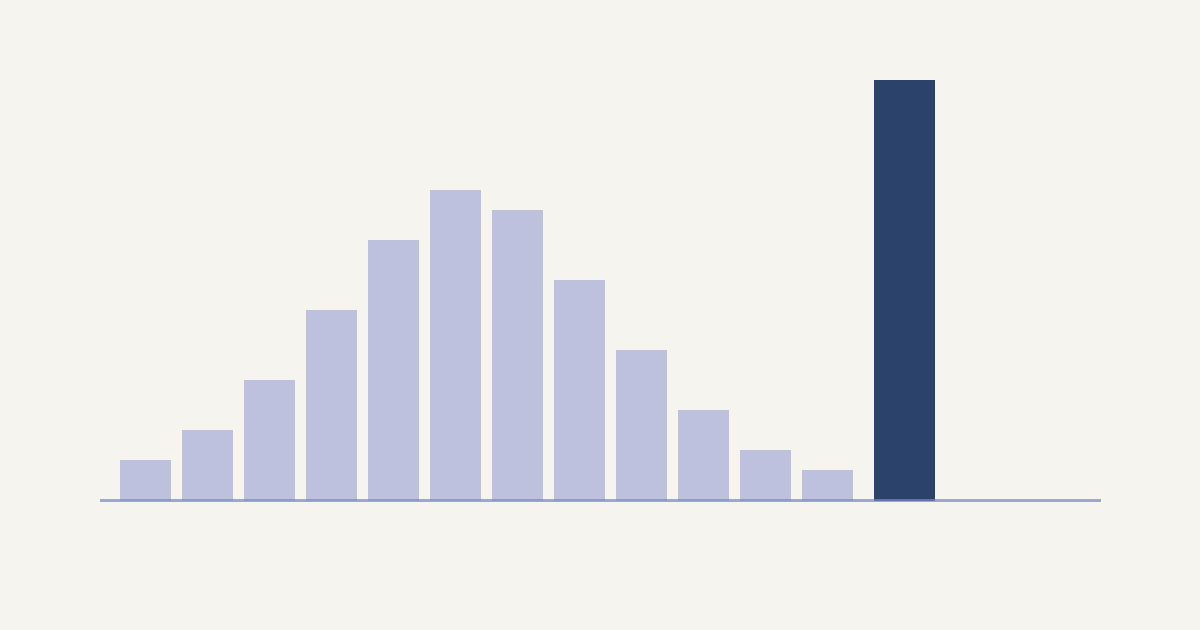
Abstract score-distribution chart in periwinkle with one anomalous navy bar at the far right

In spring 2026, a Brown University economics professor reported that his class had produced an unusual result: on a take-home midterm taken by 86 students, 40 scored a perfect 100. That reported anomaly, and not any detection software, is what triggered what Fortune described as the largest known AI-assisted cheating scandal in the Ivy League. The allegations have not been adjudicated, so this article treats them as allegations. What makes the case worth studying is what it reveals about AI cheating in university exams as a collective pattern, and about how institutions notice it.

What was reported

Professor Roberto Serrano moved his advanced economics course (ECON 1170) to take-home exams after a December 2025 shooting on the Brown campus, on the grounds that many students were anxious about sitting in a classroom, according to Inside Higher Ed. Reporting on his account states that the class average on the take-home midterm was about 96, against a usual range of roughly 65 to 80, despite an exam he considered harder than in previous years. He and his graders reportedly ran the questions through ChatGPT and found that many student answers mirrored its output in logic and phrasing. He told students he suspected widespread use of AI and moved the final exam in person. Other outlets have reported the number of implicated students as at least 50; that figure comes from his account, not from a finding by the university.

The institutional response, and the disagreement over it

Serrano has said the university acted only after his account was published by the Spanish newspaper El Pais in late June. A Brown spokesperson told the Boston Globe that the academic code committee had been waiting for more information from him and opened its investigation as soon as he provided it on July 8, and that academic leaders had been in contact with him about the adjudication process earlier. The two accounts are not reconciled in public reporting, and this article takes no side on them. Separately, a Brown committee on generative AI in teaching and learning published its first report in the same period; according to Inside Higher Ed, three-quarters of the 105 faculty members who gave feedback said they were concerned about students using AI to cheat.

Evidence, inference, and what remains open

CategoryWhat it contains in this case
Reported facts86 students took the exam; 40 scored 100; the average was about 96 versus a usual 65 to 80; the exam was take-home for reasons connected to campus safety
AllegationsSerrano alleges widespread AI use, at least 50 students by some reports; the university’s investigation began in July 2026 and has not produced a public finding
Our interpretationThe visible signal was a statistical anomaly in the score distribution, not the output of a detector
Not establishedWhich individual students used AI, how they used it, and whether the score pattern has any other explanation

Why the anomaly, not a detector, exposed it

This part is our interpretation, but the research supports it. AI-text detectors have documented reliability problems: a peer-reviewed 2023 study in Patterns by Liang and colleagues found that widely used detectors misclassified 61% of essays written by non-native English speakers as AI-generated. A score distribution is a different kind of evidence: it does not judge any one student’s text, it flags that a group performed in a way the exam’s history makes unlikely. That makes it useful as a trigger for review and unsuitable as proof against an individual, which is why due process still matters after the anomaly is noticed.

A contrast: not every anomaly means AI

A second 2026 case shows the limits of inferring cause from an anomaly. As CNN reported, Mexico’s UNAM annulled about 3,000 of roughly 150,000 admission exam results after an unusually high number of perfect scores, with suspicion falling on AI tools or advance access to questions. UNAM’s own investigation then reported cheating through phones, accomplices, and identity theft, and the university scheduled an in-person control exam for around 58,000 applicants. Many students also blamed the AI surveillance system meant to make the exam cheat-proof. The lesson is that an unusual score pattern establishes that something went wrong, not what, and that the remedy chosen in both cases was the same: supervised, in-person assessment.

What this means in practice

  • Match the format to what you are measuring. A take-home exam can no longer certify unaided ability unless AI use is explicitly part of the task. Where unaided ability is the goal, supervised assessment is the reliable option.
  • Plan the contingency. The Brown exam moved out of the classroom for a humane reason. Departments need an AI-resilient fallback format ready for disruptions, so that an emergency does not silently change what the exam can measure.
  • Use anomalies to open a review, not to close one. Compare cohort results with course history, then use an oral follow-up or a supervised re-test before any accusation.
  • State the rules in the assignment. Explicit, task-level AI-use rules are the operational core of a sound policy; see our guide to building an AI use policy, and AI literacy for the skills a rule alone cannot teach.

What this case does not show

It says nothing about the conduct of Brown students in general, and one class is not a survey of a university. The broader evidence on how widespread misuse is comes from aggregate counts: a Guardian investigation, summarized by The Cheat Sheet, found almost 7,000 proven AI-cheating cases at UK universities in 2023 to 2024, about 5.1 per 1,000 students, and experts described that as the tip of the iceberg because detection is uneven. The pattern also connects to a deeper question we examined in our review of the research on AI and critical thinking: what an exam is for once a capable tool is always within reach.

Key takeaways

  • The Brown case rests on allegations: 40 of 86 students scored 100 on a take-home midterm, and the university’s investigation has not issued a public finding.
  • The signal that exposed it was a score-distribution anomaly, which supports opening a review but is not proof against any individual. See do AI detectors actually work for the full evidence review.
  • UNAM’s 2026 admission-exam case shows an anomaly can have several causes, and both institutions responded with in-person assessment.
  • Practical steps: match assessment format to the skill measured, prepare AI-resilient contingencies, and write task-level AI rules into every assignment.

Sources: Inside Higher Ed (July 8, 2026); Fortune (June 2026); Boston Globe (July 15, 2026); CNN (August 2, 2026); Liang et al. (2023), Patterns, 4(7); OECD AI Incidents Monitor entry for the Brown case.

Posted on — Leave a comment

AI Companions and the Youth Mental Health Debate: What Schools Should Know

Abstract illustration in periwinkle representing protective support layers

A U.S. health advisory has now formally warned that using AI chatbots for mental health support can have unintended effects and even cause harm. That warning did not come from a skeptic of the technology in the abstract, it came in response to a documented pattern now working its way through American courts: companion chatbots that responded to expressions of serious distress in ways that validated the crisis rather than redirecting the person toward real help.

If you or someone you know is struggling, the 988 Suicide & Crisis Lifeline (call or text 988 in the US) is available 24/7. This article discusses this topic at a factual, pattern level and does not describe specific methods or reproduce harmful chatbot messages.

What the court filings describe

In January 2026, Character.AI and Google reached settlements with five families whose children experienced severe mental health crises or died by suicide after extensive use of a companion chatbot. Additional lawsuits against OpenAI and other companies remain active in courts across California, Florida, New York, Colorado, and Texas. Reviews of these filings describe a consistent pattern, not isolated incidents: products with no clinical validation for the mental-health use cases that emerged organically among users, no escalation pathway when a user expressed crisis-level distress, and design choices that safety researchers say prioritized engagement over intervention.

What the research shows, and its real limits

A 2026 study of more than 20,000 U.S. adults found that people who used generative AI daily had roughly 30% higher odds of reporting moderate or severe depressive symptoms than people who did not use it. This is a correlational finding, not proof that AI use causes depression; it is equally consistent with people already experiencing distress turning to AI companionship more often. What the finding does establish is that the association is real and large enough to take seriously, alongside the specific, documented failure pattern in the court filings above.

Why regulators are now involved

The Federal Trade Commission has opened an investigation into how companion-chatbot companies monetize user engagement and what protections exist for children and vulnerable users specifically. Separately, lawmakers have moved toward stricter rules for chatbot platforms used by minors, including age verification requirements. This is a case where litigation, a formal health advisory, and regulatory investigation are converging on the same conclusion at roughly the same time, which is a meaningfully different situation from an emerging, contested concern.

What this actually means for schools

This is a distinct risk category from the academic-integrity and learning-outcome questions covered elsewhere on this site, and it needs to be treated as one. A school’s AI use policy, see our guide to building one, should explicitly address companion and general-purpose chatbot use outside instructional contexts, not just classroom tool adoption, because that is where this specific risk pattern has actually emerged. Practically, that means: staff and counselors should know the warning signs of a student substituting chatbot interaction for real relationships (increasing secrecy about online activity, withdrawal from friends or family, describing an AI as understanding them better than people do), and schools should have a clear, known pathway to real mental health support that does not depend on a student disclosing distress to an AI first.

The distinction worth holding onto

None of this is an argument that AI conversation is inherently harmful, or that every student using a chatbot is at risk. The documented failures involve a specific pattern: general-purpose or companion products, not clinically designed tools, used as a substitute for real crisis support, with no safeguard to catch the moment where casual use became a mental health emergency. The FTC’s own framing, engagement-optimized design without adequate protection, points at the design choice, not the technology category as a whole. That distinction matters for how schools respond: the answer is not banning AI conversation, it’s making sure a real safety net exists underneath it.

Key takeaways

  • A U.S. health advisory, active litigation across five states, and an FTC investigation are converging on the same documented pattern: companion chatbots with no crisis-escalation pathway.
  • A 2026 study found a real, statistically significant association between daily AI use and depressive symptoms; this is correlational, not proof of causation.
  • School AI policies need to explicitly cover companion and general-purpose chatbot use outside the classroom, a distinct risk category from academic tool adoption.
  • The documented failure is a design and safeguard problem, not evidence that AI conversation itself is inherently harmful.

Sources: settlement and litigation reporting via multiple U.S. legal outlets and the American Bar Association (2026); Federal Trade Commission investigation announcements (2026); peer-reported 2026 survey study on generative AI use and depressive symptoms.

Posted on — 3 Comments

AI Literacy: What It Actually Means (and Why the Definition Keeps Changing)

Abstract illustration in periwinkle representing layered AI literacy frameworks

AI literacy does not have one settled definition, and that is not a flaw in the field, it reflects a genuinely fast-moving policy landscape. In June 2026, the OECD and the European Commission jointly published AILit (Empowering Learners for the Age of AI), a new international reference framework for primary and secondary education, built on top of, not replacing, earlier work like UNESCO’s 2024 AI Competency Framework for Teachers. Understanding why there are multiple frameworks, and what they actually agree on, is more useful than memorizing any single one.

Why there isn’t just one framework

FrameworkWho it’s forWhat it covers
UNESCO AI Competency Framework for Teachers (2024)Educators specificallyWhat teachers need to know and be able to do to use AI responsibly in their own practice
AILit / Empowering Learners for the Age of AI (OECD + European Commission, June 2026)Primary and secondary studentsFour domains, Engage, Create, Manage, Shape AI, across 19 competences and three learner progression levels
Stanford Teaching Commons frameworkHigher-education instructorsFour domains: functional, ethical, rhetorical, and pedagogical AI literacy

These aren’t competing definitions so much as different frameworks built for different audiences and grade bands, and they deliberately build on shared foundations: AILit explicitly draws on AI4K12, UNESCO’s earlier work, and the EU’s DigComp 3.0 digital competence framework rather than starting over. The practical takeaway is that the underlying skills are converging even as the specific documents multiply.

What these frameworks actually agree on

Strip away the differing terminology, and a consistent core shows up across nearly every framework in this space: understanding at a basic level how an AI system works and where its limits are, using AI tools effectively for a real task, evaluating AI output critically rather than accepting it, and reasoning about the ethical and social implications of AI use. AILit’s own draft definition states this plainly: AI literacy provides a clear understanding of how AI technologies work and what their responsible use entails, so learners can make informed decisions, grounded in trusted information, ethics, and social good.

Why this is becoming a legal requirement, not just good pedagogy

AI literacy has moved beyond curriculum recommendation in at least one major jurisdiction. Article 4 of the EU AI Act, applicable since February 2025, requires that anyone deploying an AI system ensures the people using it, including students and educators, have a sufficient level of AI literacy. AILit is explicitly designed to help schools meet that requirement in practice, and it is also linked forward to the PISA 2029 Media and AI Literacy (MAIL) assessment, meaning AI literacy is on a path toward being measured internationally, not just taught inconsistently.

What this means for teaching it in practice

Rather than waiting for a single finalized standard, or trying to teach every framework’s full competence list, the practical starting point is the four-part core above: how AI works at a basic level, how to use it for a real task, how to evaluate its output, and how to reason about its implications. This lines up directly with how we’ve covered AI and critical thinking on this site: the evaluation and verification piece of AI literacy is exactly the skill that research shows is most at risk when AI use isn’t structured deliberately. It also connects to building an AI use policy, since a policy without a literacy component to back it up is difficult to actually implement in a classroom.

Key takeaways

  • Multiple AI literacy frameworks exist because they serve different audiences (teachers vs. students vs. higher-ed instructors), not because the field disagrees on fundamentals.
  • A consistent core spans nearly all of them: how AI works, using it effectively, evaluating its output, and reasoning about its implications.
  • The EU AI Act’s Article 4 makes AI literacy a legal requirement in at least one major jurisdiction, not just a pedagogical nice-to-have.
  • AILit is explicitly linked to the PISA 2029 MAIL assessment, meaning AI literacy is moving toward being measured, not just taught inconsistently.

Sources: OECD and European Commission, AILit / Empowering Learners for the Age of AI (June 2026); Miao, F., & Cukurova, M. (2024). AI Competency Framework for Teachers. UNESCO; Stanford Teaching Commons, Understanding AI Literacy.

Posted on — 3 Comments

Building an AI Use Policy for Your School or Training Program

Abstract illustration in periwinkle representing tiered AI policy guidance

A usable AI policy does not start from a blank page or a generic template. It starts from a simple structural idea that UNESCO’s own guidance uses: not all AI use in a school carries the same level of risk, so a policy should not treat it as if it does. Administrative AI, teacher-support AI, and student-facing AI each need different rules, different oversight, and different levels of caution, and conflating them is the most common reason school AI policies end up either too vague to use or too restrictive to survive contact with an actual classroom.

Start with UNESCO’s three-tier structure

UNESCO’s Guidance for Generative AI in Education and Research groups AI applications into three confidence tiers, and building a policy around this structure, rather than one flat set of rules, is the single most useful starting decision a school can make.

TierExamplesUNESCO’s confidence level
Administrator-facingScheduling, predictive analytics, language access toolsHighest current confidence
Teacher-supportingLesson planning assistance, formative assessment help, grading time-savingsMedium-high confidence
Student-facing generative AIStudents directly using chatbots or generative tools for courseworkLowest confidence; UNESCO explicitly flags this as too new for stable, settled policy

Practically, this means your policy should be least restrictive and most settled for administrative tools, moderately structured for teacher use, and most cautious and most subject to revision for student-facing tools. A single blanket rule across all three (either “AI is banned” or “AI is allowed”) ignores a distinction UNESCO itself considers foundational.

The four principles underneath the tiers

Beneath the three tiers, the OECD’s AI Principles supply the operating rules that should govern any AI use in any tier: human-in-the-loop on consequential decisions, transparency to the people the AI affects (students, parents, staff), explainability of what the AI actually did, and clear accountability for whoever deployed it. These four principles are what should actually appear as concrete policy language, tier by tier, rather than staying abstract.

For example, applied to a teacher-supporting grading tool: human-in-the-loop means the teacher, not the tool, assigns the final grade. Transparency means students and parents know AI assisted the process. Explainability means the teacher can say what the tool flagged and why. Accountability means the school, not the vendor, owns the outcome.

Why this is becoming a legal requirement, not just good practice

This is no longer purely a best-practice recommendation in every jurisdiction. North Carolina’s 2026 state law, for instance, requires the state Department of Public Instruction to adopt a model AI policy by the end of 2026, and requires every local school district, charter school, and affiliated school system to adopt their own policy based on it by mid-2027. The EU AI Act goes further for systems used in assessment and admissions specifically, classifying them as high-risk and requiring formal risk management, data governance, human oversight, and conformity assessment before deployment, with phased enforcement running through 2026-2027. Even where no law yet mandates a policy, this direction is clearly where the regulatory environment is heading, which makes building one proactively, on a sound structure, more useful than waiting to be required to.

What a usable policy document actually contains

Real school AI policies that are actually in use, rather than aspirational documents, tend to share a consistent structure: a stated purpose, a defined scope (which staff, students, and visitors it covers), the legal framework it operates under, clear definitions of what counts as AI use, defined roles and responsibilities for oversight, a section on appropriate use, a section on misuse and its consequences, an implementation plan, and a scheduled review mechanism, typically annual, given how quickly the underlying tools and regulations are changing.

That review cadence matters as much as the initial content. A policy written once and left untouched will be describing tools and rules that no longer match reality within a year, given the pace covered in our explainer on AI agents and elsewhere on this site.

Before approving any specific tool under the policy

A policy sets the rules; it does not evaluate individual tools against them. For that step, use a structured process rather than a vendor’s own claims, our framework for evaluating an AI tool covers exactly the data-handling and oversight questions the OECD principles above require you to be able to answer before approving a tool for classroom use. A sound policy also depends on a literacy component; see AI literacy: what it actually means for the skills a policy alone cannot teach. For a live 2026 case of what happens when assessment rules do not match AI use, see the Brown University AI cheating case.

Key takeaways

  • Structure your policy around UNESCO’s three confidence tiers, administrator, teacher-support, and student-facing, rather than one flat rule for all AI use.
  • Apply the OECD’s four principles, human-in-the-loop, transparency, explainability, accountability, as concrete language within each tier, not as abstract values.
  • This is increasingly a legal requirement, not just best practice; North Carolina and the EU AI Act are early examples of a broader regulatory direction.
  • Build in an annual review cycle; a static policy will fall out of date faster than the tools it governs.

Sources: UNESCO, Guidance for Generative AI in Education and Research (2023, updated 2024); OECD AI Principles (2019, updated 2024); EU AI Act (2024); North Carolina General Statutes §115C-102.13 (2026).